The Results Page Changed: Where Your Customers Actually Click Now
Your customers see an AI answer before they see your website. What is on a results page now, what the lost clicks cost you, and how to become the source the answer is built from.
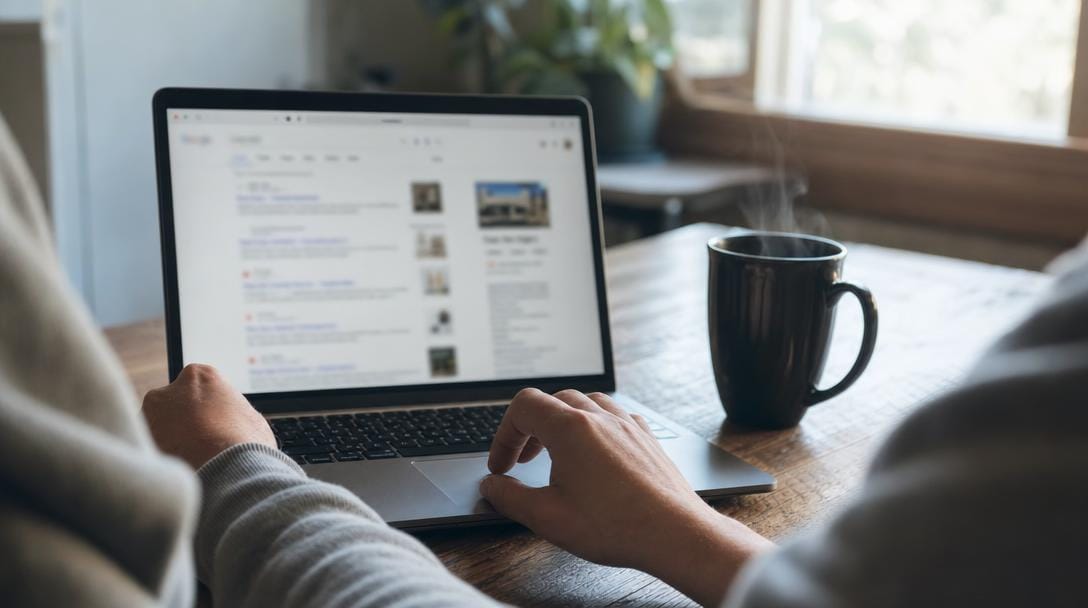
Search your own business the way a customer would. Not your company name — the thing you sell, the way a stranger would type it. What loads is probably not what you expect: an AI-written answer at the top, a block of ads under it, a map with three competitors, a row of questions, and then, somewhere below the fold, the first actual website.
That page is where your customers decide who to call. This explains what is on it now, why fewer people click through than they used to, and what a business can realistically do about it.
What is a SERP, in plain English
A SERP is the page of results you get after typing something into Google. The letters stand for Search Engine Results Page. That is the entire definition — and until a few years ago it was an accurate description of a simple thing: ten blue links, ranked best to worst.
It is not that any more. Today the results page is a layout of competing blocks, most of which are designed to answer the question without sending anyone anywhere. Understanding that layout matters because your position in it decides how much of your market ever sees you.
What is on a SERP now
A typical commercial search puts these in front of your customer, roughly in this order:
| What appears | What it does to you |
|---|---|
| AI answer at the top | Answers the question directly, citing a few sources. If you are not one of them, the customer may never scroll. See AI Overviews. |
| Paid ads | Four slots that can be bought instantly. They push the free results down the page. |
| Map pack (local searches) | Three businesses with stars and a phone number. For anything "near me", this is where the calls come from — and it is not your website. |
| People also ask | Expandable questions that answer follow-ups on the page. Being quoted here is free visibility; being absent is invisibility. |
| Organic results | The classic list. Still the biggest source of steady, unpaid customers — but now the fourth thing your customer sees, not the first. |
The important shift is not that new blocks were added. It is that the top of the page stopped being a list of places to go and became an answer in itself.
Where the clicks actually go
Two things changed at once, and together they explain a lot of quiet traffic decline.
Most searches now end without a click. The person got what they needed — an opening time, a price, a definition — from the page itself. Research into zero-click behaviour has been tracking this for years, and the direction has never reversed. This is what people mean by zero-click search.
And customers increasingly do not start at Google at all. They ask an assistant, which reads a handful of pages and answers in one paragraph — no results page, no ten links, no chance to be noticed unless you are in that paragraph.
The practical consequence for a business: ranking well is no longer the same as being chosen. You can hold position four and watch clicks fall, because the answer arrived above you.
What that costs, in money
Rankings are an abstraction. Do the arithmetic instead — it takes two minutes and tells you whether this matters for your business.
Say 1,000 people a month search for what you sell. Historically, a top-three result might have earned you something like a hundred visits from that. Now suppose the AI answer at the top handles half of those searches before anyone scrolls. Your same position, unchanged, earns roughly half the visits. If one in twenty visitors becomes an enquiry and an enquiry is worth $500 to you, that is around $1,250 a month that stopped arriving — with nothing broken on your website and no drop in your ranking.
Run those numbers with your own figures: monthly searches, your rough share of clicks, your conversion rate, your customer value. The output is the number worth acting on, and it is the number to put in front of anyone quoting you for SEO work.
Why this is winnable
Here is the part that gets lost in the doom: the AI answer has to come from somewhere. It reads pages and quotes them. Someone is being cited — and whoever it is gets the credibility, the brand mention, and the click from everybody who wants detail rather than a summary.
So the goal moved. It used to be "rank on page one". Now it is "be the page the answer is built from". The good news is that the same work serves both, because the pages that get quoted are the pages that answer a specific question clearly, from a source that looks like it knows what it is talking about.
What to do about it
- Answer the question in the first two sentences. Both Google and the assistants lift short, direct answers. A page that warms up for four paragraphs before getting to the point never gets quoted.
- Write for the questions customers actually ask, in their words — including the awkward ones about price, timing and what goes wrong. Those are the searches with a buyer at the other end.
- Show who you are. Real business details, real authorship, real evidence. This is what E-E-A-T means in practice, and it is how an AI decides whose answer to trust.
- Fix your map listing if you serve a local area. For "near me" searches, the map pack is the result — hours, categories, photos and reviews do more for you there than any amount of website work.
- Own the snippet. Your title and description are your advert in the results. Check how yours renders with a snippet preview — a clearer title is the cheapest click you will ever buy.
- Cover the topic, not the keyword. One good page rarely does it; a cluster of related pages is what makes you look like the authority. See topical authority.
Should you just buy ads instead?
It is the obvious question once you see how much of the SERP is paid, and it deserves a straight answer: ads and search visibility solve different problems, and the difference is what happens when you stop paying.
Ads are rented attention. They start today, they are measurable to the cent, and they end the moment the card is declined. That makes them right for a launch, a seasonal push, or testing whether a service sells at all before you invest in pages about it.
Organic visibility is owned attention. It takes months to build and it keeps working after the spend stops. The page you publish this quarter can still be bringing in enquiries in two years, at no additional cost per click.
For most small businesses the sensible answer is not either-or. Use ads to buy immediate volume on the two or three searches that convert best, and build organic visibility underneath so that your cost per customer falls over time instead of rising with the auction. What you should not do is spend two years on ads and arrive with nothing to show for it except a stopped invoice.
Check your own SERP in ten minutes
- Open a private browser window so your own history does not flatter the results.
- Search the three things a customer would actually type. Not your brand name.
- Write down what appears above the first ordinary result: is there an AI answer, ads, a map?
- If there is an AI answer, note which sites it cites. Those are your real competitors now, whatever their ranking.
- Find your own listing. Read your title and description as a stranger. Would you click it over the one above?
- Repeat on a phone. The screen is smaller and the answer takes more of it — that is what most of your customers see.
Whatever you find, that is your starting position. It is also a task you should repeat every quarter, because this page changes faster than anything else in marketing.
The short version
A SERP is the page of results after a search, and it no longer behaves like a list of links — it is an answer with links underneath. Your customers see an AI summary first, ads second, a map third, and your website fourth. The winning move is not to fight for a position; it is to become the source the answer is built from, by answering real questions clearly and provably.
That is steady work rather than a one-off fix: keep finding the questions, keep publishing the answers, keep checking what changed. If you would rather that ran on its own, see how an AI SEO agent handles it every day — or start with the plain-language glossary entry on SERPs if you want the fundamentals first.
Möchten Sie, dass das für Sie erledigt wird – jeden Tag?
Verbinden Sie Ihre Website, und SERP Agent übernimmt Audit, Content und Veröffentlichung im Autopiloten.