AI Overviews: How Google's AI Answers Work and How to Show Up in Them
How Google AI Overviews build answers, which searches trigger them, what they do to clicks, and a practical 30-day plan to earn citations in AI answers.

AI Overviews are AI-generated answers that Google Search shows at the top of some results pages. A custom Gemini model writes each summary from pages in Google's index and links the pages it relied on, so searchers can check the answer or read further.
Google launched AI Overviews to US searchers in May 2024, powered by a custom Gemini model built for Search. For a business, this shifts the goal. Ranking on page one still matters, but on many research queries the real prize is being one of the few sources cited inside the answer.
This guide explains how Google assembles an AI Overview, which searches trigger one, and what it does to clicks. It ends with a 30-day plan a business can follow to earn more citations.
Last reviewed: September 27, 2026. Google updates its AI search features often, so check the linked Google documentation for current behaviour.

Key Takeaways
- Retrieval first, writing second. Google fans a query out into related searches, retrieves indexed pages, and has Gemini write a summary that links supporting pages, per Google's AI features documentation.
- Question-style searches trigger them most. Per Pew Research Center, 18% of Google searches in March 2025 produced an AI summary, rising to 60% for searches phrased as questions.
- Clicks drop, citations matter more. Pew Research Center found users clicked a traditional result in 8% of visits with an AI summary versus 15% without, so being cited inside the answer is the new visibility goal.
- No special technical setup. Google requires only that a page be indexed and snippet-eligible; schema markup and llms.txt are supporting extras, not requirements.
- Google-Extended is not an off switch. Google's crawler documentation says Google-Extended does not affect Search inclusion or ranking, and AI Overviews are governed by Search snippet controls such as nosnippet.
What Are AI Overviews?
AI Overviews are generated answer panels in Google Search: a short summary written by AI, plus links to the web pages that support it.
The feature started as the Search Generative Experience (SGE), an opt-in experiment. Google first previewed SGE in Search Labs in May 2023, then renamed it and launched it as AI Overviews a year later. By May 2025, Google reported that AI Overviews had more than 1.5 billion monthly users.
For a short reference version, see the Google AI Overviews definition in the glossary. The part that matters most for a business is the links. Google calls them supporting links. The industry calls them AI citations, and they are now a core unit of visibility on the results page.
How Google Builds an AI Overview, Step by Step
Google searches first and writes second: it retrieves relevant pages from its index, has Gemini write an answer from them, and attaches links to the pages that support the response.
Here is the pipeline in plain terms:
- Query understanding. Google works out what the searcher wants, including the sub-questions hidden inside the query.
- Query fan-out. Google's AI features documentation says AI Overviews and AI Mode may use a "query fan-out" technique, running multiple related searches across subtopics to build one response.
- Retrieval. Those searches pull candidate pages from the regular Google index. The same documentation states that a page only needs to be indexed and eligible to show a snippet to qualify as a supporting link.
- Synthesis. Gemini drafts a summary from the retrieved material.
- Grounding and citation. Google attaches links to the pages that back up the generated text, which can include pages outside the classic top ten.
Here's the practical implication. Because of fan-out, a page can be cited for one sub-question even when it does not rank for the main query.
And because the system works from retrieved text, a paragraph that answers one question on its own is easier to use than a strong page that buries the answer halfway down. Passage-level clarity beats page-level polish.
Which Searches Trigger an AI Overview
Long, question-style informational searches trigger AI Overviews most often, while short navigational searches such as a brand name trigger them far less.
Pew Research Center's analysis of real browsing data found that 18% of Google searches in March 2025 produced an AI summary. The same study found that searches phrased as questions produced one a significant share of the time, and searches of ten words or more did so a significant share of the time.
Google does not publish a trigger list, and coverage shifts as the feature expands to new languages and query types. For a business owner, though, the trigger queries look familiar. They are the research questions buyers type before contacting anyone:
- 'How much does [service] cost?'
- '[Option A] vs [option B] for a small business'
- 'Is [product type] worth it?'
- 'How do I choose a [provider]?'
Branded searches usually return the brand's own website first. The research phase before that branded search is where AI Overviews do most of their filtering, deciding which businesses the buyer hears about at all.
AI Overviews vs Featured Snippets vs AI Mode
A featured snippet quotes one page, an AI Overview writes a new answer from several pages, and AI Mode is a separate conversational search experience that does the same in more depth.
| Feature | What triggers it | Where citations appear | Click behaviour |
|---|---|---|---|
| Featured snippet | Queries where one page answers the question directly | A single source link under the quoted excerpt | One prominent link to the quoted page |
| AI Overview | Informational queries where Google decides a summary helps, especially longer questions | Source cards and inline link icons beside the summary | Pew's study found links inside the summary are rarely clicked |
| AI Mode | The searcher chooses AI Mode | Source links alongside each conversational answer | Follow-up questions keep the searcher in the conversation |
Google's featured snippet documentation describes snippets as excerpts pulled from a single page. AI Mode goes further. Google rolled AI Mode out to all US users in May 2025 and describes it as using query fan-out more extensively to handle complex, multi-part questions.
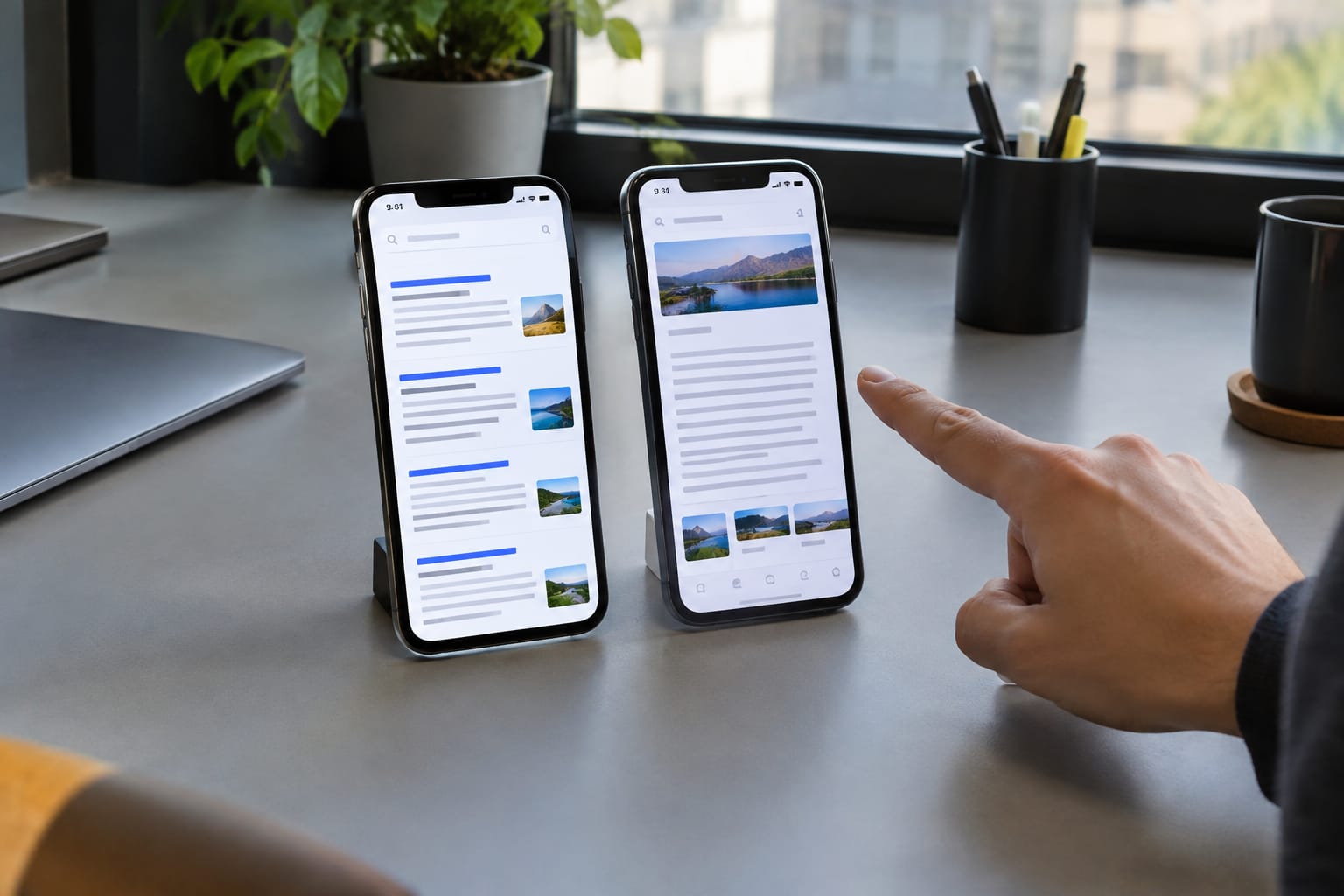
Q: What is the difference between a featured snippet and an AI Overview?
A: A featured snippet shows an excerpt copied from one page, per Google's featured snippet documentation. An AI Overview is new text written by Gemini from several pages, with multiple source links.
The overlap is useful. A page built to win a featured snippet, with a clear heading and a direct answer beneath it, already has the shape that AI systems can lift and cite.
What AI Overviews Change About Clicks and Traffic
On queries that show an AI Overview, fewer searchers click through to websites; independent studies measure a clear drop, while Google argues the remaining clicks are more valuable.
In the Pew study, users who saw an AI summary clicked a traditional search result in 8% of visits, versus 15% when no summary appeared. Users clicked a link inside the summary itself in just 1% of visits.
A separate Ahrefs analysis associated AI Overviews with a 34.5% lower click-through rate for the top-ranking page. Different methods, same direction: less traffic per ranking.
Google presents the other side. Google reports that AI Overviews drive more than a a significant share increase in usage for the types of queries that show them in markets like the US and India. Its AI features documentation also states that clicks from results pages with AI Overviews are higher quality, with visitors more likely to spend time on the site.
This is the latest stage of zero-click search, where a search ends on Google without a visit to any website. What does it mean for a business? Three things:
- Visibility without a visit still counts. A cited brand is seen by the searcher even when nobody clicks.
- Sessions are the wrong scoreboard. Leads, calls and sales show whether search is working; raw traffic understates it.
- Being cited beats ranking below the answer. A page ranked third but uncited sits under a summary that already answered the question.
How Google Chooses Which Sources to Cite
Google has not published a citation formula; it documents eligibility and its general quality systems, and everything beyond that comes from observing which pages actually get cited.
The documented part is short. A page must be indexed and snippet-eligible, and the same ranking and quality systems that power regular Search apply. Google's guidance on helpful, reliable, people-first content sets the standard, built around E-E-A-T: experience, expertise, authoritativeness and trust.
The observed part comes from tracking live citations. Cited passages tend to share a few traits:
- They answer one sub-question directly, close to a relevant heading.
- They contain specifics: sourced numbers, named steps, clear definitions.
- The site covers the topic across several connected pages, which builds topical authority.
- The business is described consistently on its own site and elsewhere on the web.
Two case studies published on this site show what this looks like with real businesses. Born to Move, a mover running jobs across Boston, Chicago, Los Angeles and Miami, logged 1,328 verified citations in AI answers across 1,475 brand mentions. Over the same period, its organic clicks grew from 770 per month in February 2026 to 1,925 per month in July 2026.
The same company ranks first for its brand name in every city it serves and second for the non-branded query 'moving company malden'. Virtual Estimate, a B2B business, recorded 56 verified ChatGPT citations for high-intent queries and reports paying customers who found it through ChatGPT.
Neither case isolates a single tactic. What they show is that AI citations grew alongside organic clicks and brand demand rather than replacing them. For a deeper dataset, see what verified AI citation data shows about getting cited.
How to Write Content That Gets Cited
Answer one question per section in the first sentence, back it with specifics, and write every paragraph so it makes sense when read on its own.
This discipline has several names: answer engine optimization for answer boxes and assistants, and generative engine optimization for AI-written answers. For the bigger picture, see how AEO differs from traditional SEO and what AI SEO covers in practice.
The citation checklist:
- Phrase each heading as the question a buyer actually types.
- Answer that question in the first one or two sentences under the heading.
- Name the subject in full instead of opening with 'it' or 'this', so the passage stands alone.
- Support each key claim with one concrete fact: a timeframe, a named standard, a figure from a cited source.
- Use tables for comparisons and numbered lists for processes.
- Cover the follow-up questions a buyer asks next, on the same page or a linked one.
- Show first-hand experience with real process steps, real photos and a named author.
- Keep business facts identical across the website, business profiles and directory listings.
- Update time-sensitive pages and display the review date.
- Link related pages together so Google can see the depth of coverage.

Pro Tip: Read the first sentence of each section in isolation. If it answers the heading without the rest of the page, the passage is ready to be quoted. If it needs context, rewrite it.
Technical Groundwork: Crawl Access, Schema and llms.txt
AI Overviews need no special technical setup: Google requires only that a page be indexed and snippet-eligible, so schema markup and llms.txt are helpful extras rather than entry tickets.
Crawl access
Google's AI features guidance states there are no additional technical requirements beyond the standard Search technical requirements. In practice, that means Googlebot can crawl the page, robots.txt does not block it, and the page is indexable. Most citation problems at this level are ordinary indexing problems.
Schema markup for AI search
Schema markup is code that labels page content for machines: the business name, a product, an author, a price. It helps Google identify the entities on a page, and it must match the visible content.
It is not a shortcut. Google restricted FAQ rich results to well-known government and health websites in August 2023, so FAQ markup no longer earns extra results-page space for most businesses. Accurate Organization, LocalBusiness, Product and Article markup remains worth adding.
Q: Does schema markup help you appear in AI Overviews?
A: Not directly. Google's AI features documentation lists no special schema requirement; markup helps Google understand entities but does not substitute for a clear, well-sourced answer on the page.
llms.txt
llms.txt is a proposed standard: a markdown file at the root of a website that summarises the site and points AI models to its most useful pages. Google's AI features documentation does not list it as a requirement. Treat llms.txt as low-cost preparation for AI assistants that read it, not as a Google ranking lever. A simple way to create one is to generate an llms.txt file and review it before uploading.
How to Measure Your AI Overview Visibility
Google Search Console counts AI Overview and AI Mode traffic inside its standard Performance report but does not separate it, so tracking citations requires manual checks or a dedicated AI visibility tool.
Google's documentation confirms that traffic from AI features is included in Search Console's Performance report under the Web search type. Clicks and impressions appear there, but no flag shows whether a page was cited in an AI Overview.
Q: How do I track whether my site is cited in AI Overviews?
A: Google Search Console does not report AI Overview citations separately. Check priority queries in Google on a fixed schedule, or use a tracker that samples AI answers from Google and ChatGPT.
A workable routine:
- List the 20 to 50 buyer questions that matter most to revenue.
- Check each one weekly: does an AI Overview appear, and which domains are cited.
- Record brand mentions in AI answers across Google AI Overviews, ChatGPT and Perplexity.
- Connect it to leads by adding an 'AI assistant' option to 'How did you hear about us?' forms.
- Feed the results into the next cycle: expand topics that earn citations and refresh pages whose visibility decays.
Manual checks get unreliable at scale, because AI answers vary by location, device and session. Tools that track your visibility in ChatGPT and Google AI automate that sampling and keep a consistent history.

Can You Opt Out of AI Overviews?
Site owners can limit how their content appears in AI Overviews with snippet controls or noindex, but those controls also shrink regular search listings, and blocking Google-Extended does not remove a site from AI Overviews.
Google's robots meta tag documentation lists the available controls:
- nosnippet blocks text snippets everywhere in Search, including AI features.
- data-nosnippet hides specific sections of a page from snippets.
- max-snippet caps how much text Google can show.
- noindex removes the page from Search entirely.
Google-Extended is the question competitors tend to dodge. Google's crawler documentation states that Google-Extended does not affect a site's inclusion or ranking in Google Search; it governs use of content for Gemini models. AI Overviews are part of Search, so Google-Extended is not the switch for them.
Blocking Google-Extended costs no Search visibility. It also does not keep content out of AI Overviews. For a business that wants customers from search, opting out through snippet controls usually trades a small gain in control for a large loss in visibility.
A 30-Day Plan to Improve AI Overview Presence
One focused month covers the fundamentals: audit the buyer questions that show AI Overviews, rewrite key pages answer-first, clean up technical signals, and set a measurement baseline.
- Week 1: Audit. List priority buyer questions, search each one, and record whether an AI Overview appears and who it cites. Confirm key pages are indexed and not blocked in robots.txt.
- Week 2: Rewrite. Restructure the top pages answer-first using the checklist above. Add sourced specifics and first-hand detail where claims are currently generic.
- Week 3: Fill gaps and fix signals. Publish pages for sub-questions no page currently answers, link them to related pages, and add accurate schema markup and an llms.txt file.
- Week 4: Measure. Re-check the same queries, compare against the Week 1 baseline, and pick the next topics to expand or refresh.
Citations often lag behind changes, because Google needs to recrawl pages and results shift over time. No plan guarantees a citation. The advantage goes to businesses that run this loop every month rather than once.
For owners without time to run that loop themselves, the real decision is who runs it. This comparison of in-house, agency and autonomous SEO options lays out the trade-offs.
Related Articles
- AEO vs SEO: What Changes When Answers Replace Blue Links — how optimising for answers differs from optimising for rankings, and what stays the same.
- Google AI Overviews: What Verified AI Citation Data Shows About Getting Cited — the patterns that show up in pages actually cited in AI answers.
- How AI Search Is Rewriting the Rules of SEO in 2026 — the wider shift from blue links to AI answers across search engines and assistants.
- What Is an SEO Agent? How Autonomous SEO Execution Works — how automated systems handle audits, content and tracking without manual work.
- SEO Services: In-House, Agency, or Autonomous Software? — the cost and time trade-offs of each way to get SEO done.
Useful Links
- AI Search SEO — Rank in ChatGPT & Google AI
- Google AI Overviews — What They Are & How to Appear
- Free llms.txt Generator — Help AI Cite Your Site
- What Is GEO? Generative Engine Optimization
- SEO Case Studies: Real Client Growth
Need help with this? Get started
Möchten Sie, dass das für Sie erledigt wird – jeden Tag?
Verbinden Sie Ihre Website, und SERP Agent übernimmt Audit, Content und Veröffentlichung im Autopiloten.